
Stopping Repeat Stairwell Offences with Intelligent Security Deterrence
A Melbourne CBD commercial building was experiencing serious and recurring misuse of its internal fire stairwells.
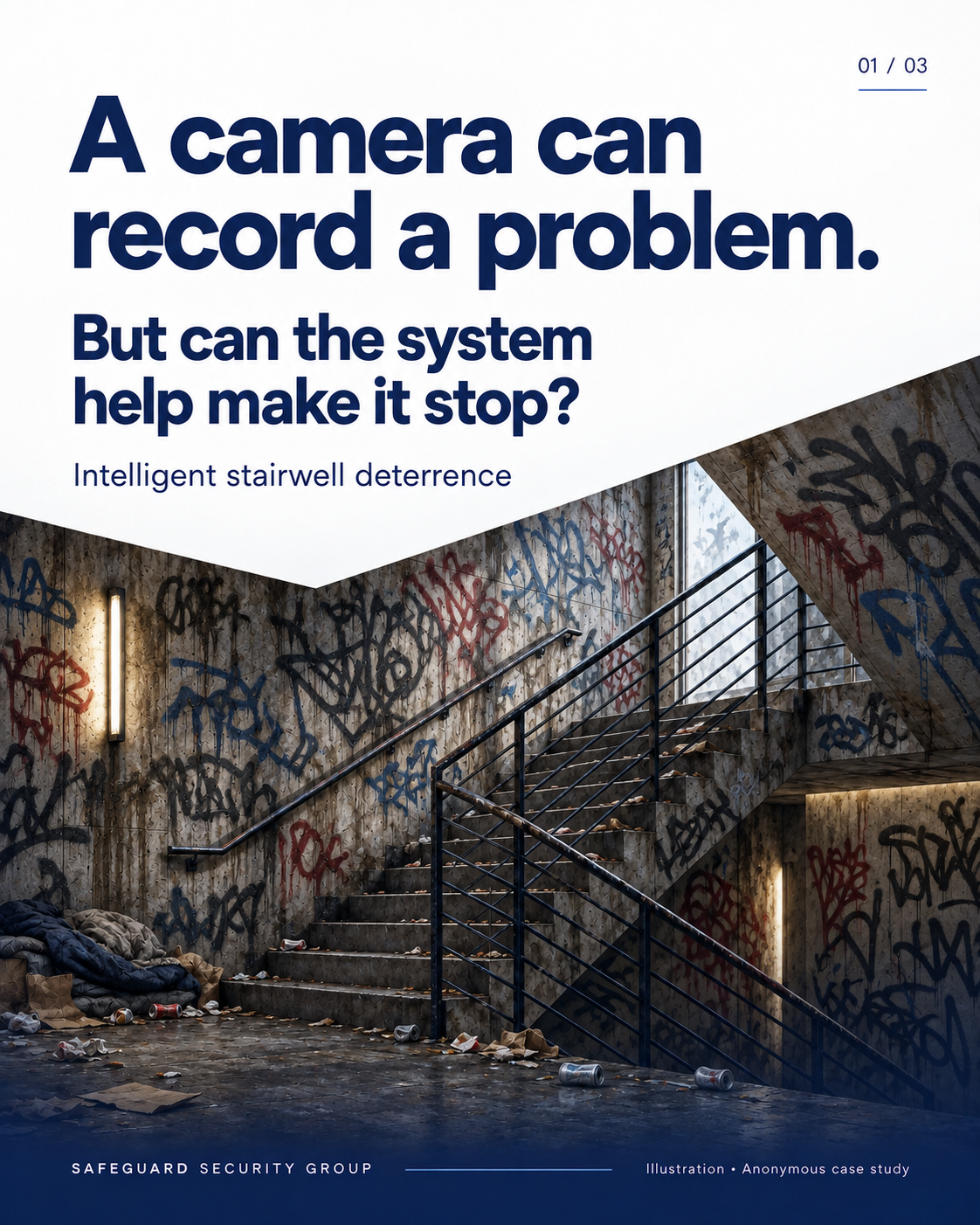
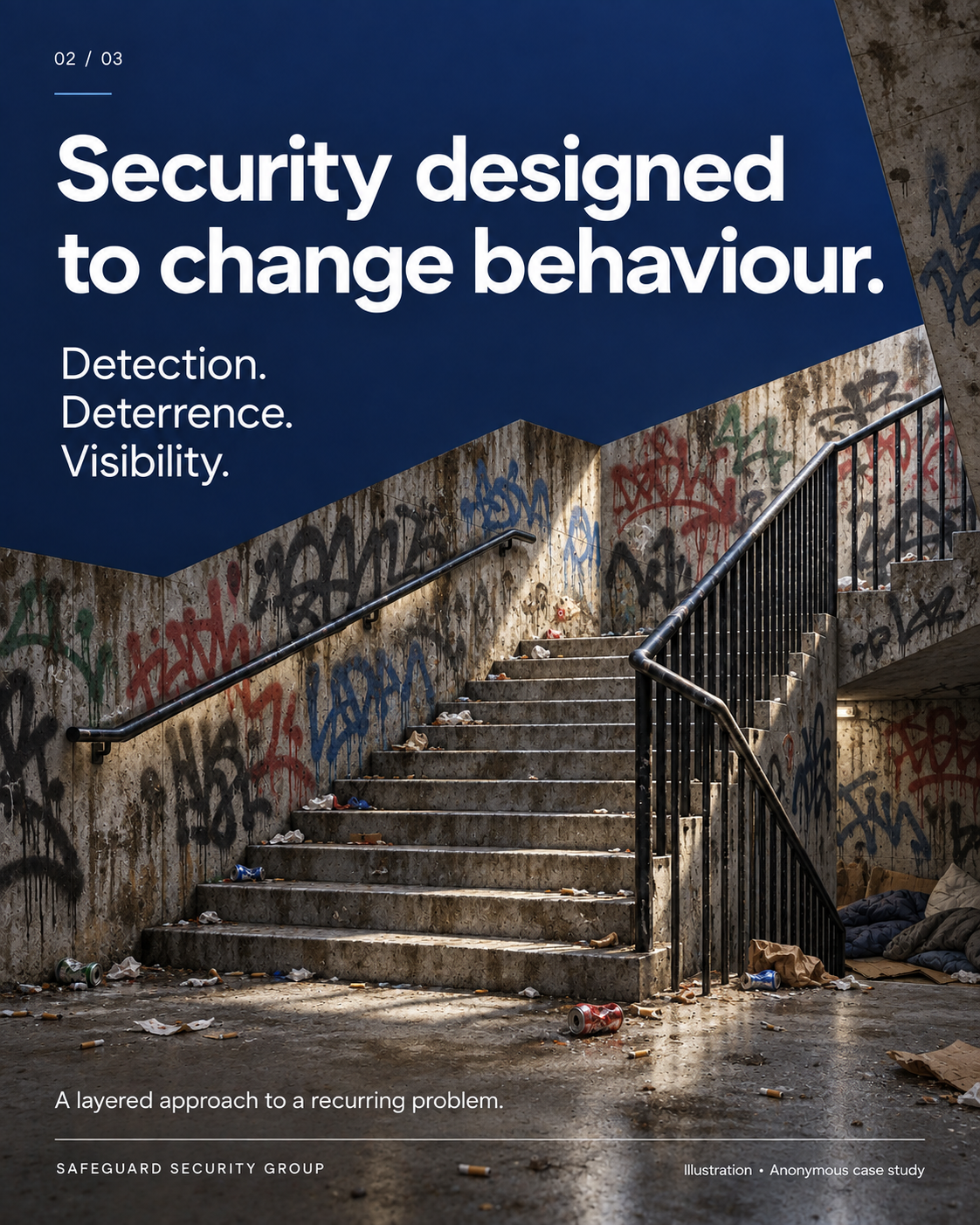
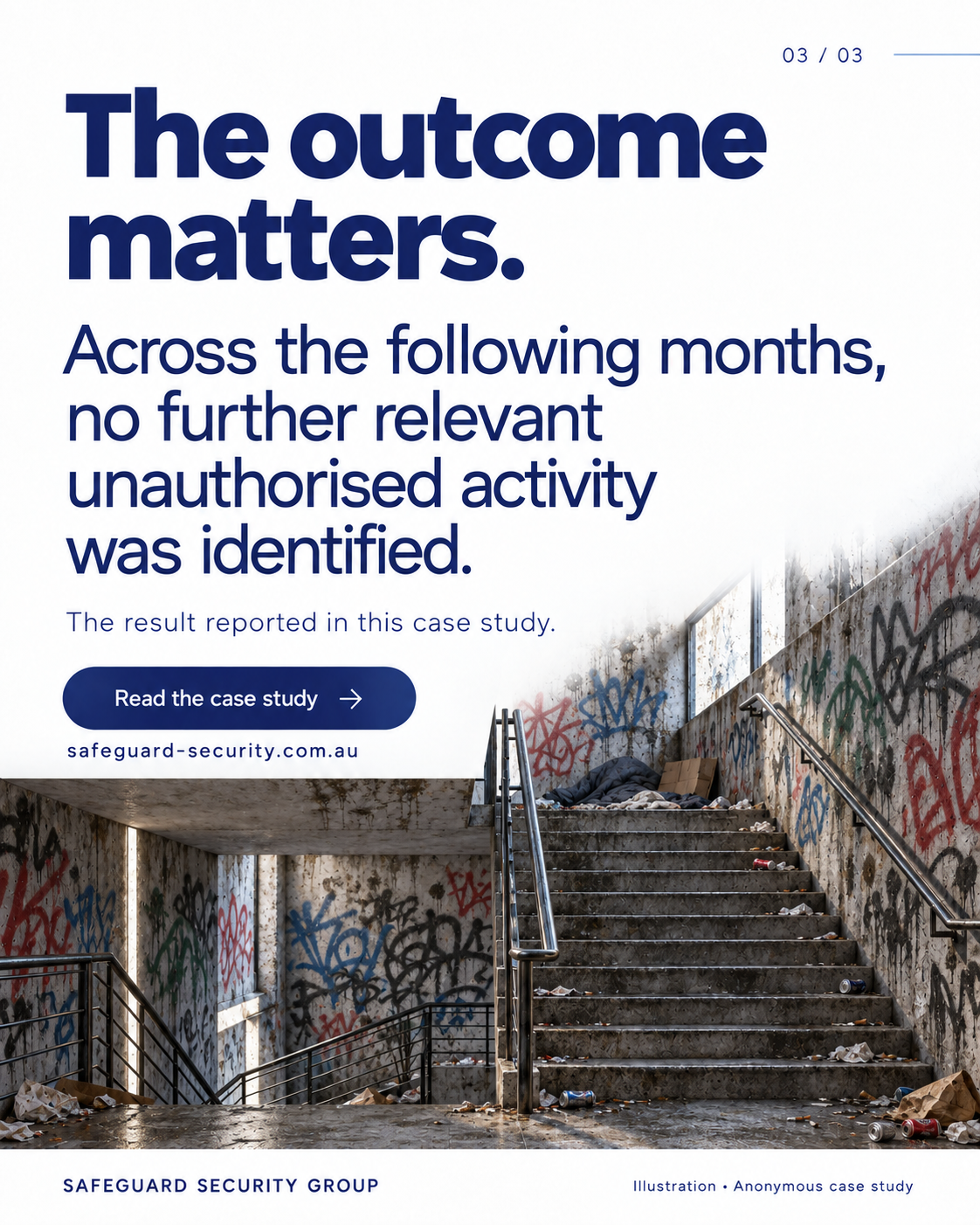
Because the stairwells could be accessed from public areas during business hours, they had become attractive spaces for unauthorised activity. Building management had dealt with drug use, sleeping, smoking, vandalism, theft, attempted break-ins, sexual activity, inappropriate photography, and people urinating and defecating in the stairwells.
The consequences went beyond inconvenience. There were ongoing concerns around occupant safety, hygiene, cleaning, property damage and the practical difficulty of getting a physical response to site quickly enough.
The limitation of a traditional response
Traditional CCTV could show what had happened, but recording an incident after the event was not solving the underlying problem.
Daytime patrol attendance was often difficult to obtain at short notice, while police understandably had competing priorities. Even when someone attended, the people responsible had often already left.
On one occasion, a significant incident involving extensive drug use by a group required police attendance.
Safeguard concluded that the building needed more than passive surveillance and a response that depended on somebody arriving later. The security system itself needed to become part of the deterrent.
Designing from the offender’s perspective
Instead of starting with the question, “What camera should we install?”, Safeguard approached the problem differently:
If I were using this area for unauthorised activity, what would make me leave — and what would make me decide not to come back?
That became the design principle.
The stairwells had been attractive because they offered privacy, anonymity and the belief that nobody knew somebody was there. The new design needed to remove those advantages.
A layered deterrence strategy
Safeguard designed a layered security response combining intelligent CCTV, AI-based human detection, local audible and visual deterrence, control-room event notification, evidentiary recording and CCTV system-health monitoring.
When unauthorised occupation is detected, the environment no longer behaves like a quiet, unnoticed space. The person becomes aware that their presence has been identified and that the building is responding.
The purpose is not simply to collect better footage. It is to make the location unattractive for the behaviour that had repeatedly been occurring there.
The detailed detection and response logic is intentionally not published. Security systems should be understood by the people responsible for protecting the building, not by those attempting to defeat them.
The system was challenged
The upgraded security was also tested by deliberate attempts to interfere with the CCTV.
In one recorded incident, an individual used a long object in an attempt to place material over a camera and obstruct its view.
The interference did not go unnoticed. The security system responded and a separate CCTV health-monitoring platform also identified that the camera image had materially changed.
This demonstrated an important part of the design: a security system should not only detect activity in the protected area — it should also identify when somebody is attempting to interfere with the security system itself.
Measuring whether it worked
Safeguard did not install the system and simply assume that the problem had been solved.
A detailed post-installation CCTV review was carried out at no charge to the building. Activity across both stairwells was reviewed over several weeks.
The change was significant.
- Unauthorised stairwell activity substantially reduced.
- AI human detection operated as intended.
- Attempts to interfere with the CCTV system were detected and recorded.
- The deterrence functions operated as designed.
- The regular loitering and prolonged occupation previously experienced was no longer evident.
- The recurring anti-social behaviour that had driven the project substantially reduced.
The system was no longer simply documenting a recurring problem.
It was changing behaviour.
What happened next was even more important
Safeguard continued reviewing motion and recorded activity after the initial assessment.
Across the following months, no further relevant unauthorised events were identified within the monitored stairwells.
The areas that had previously generated repeated incidents, complaints and security concerns were effectively quiet.
The system activity also provided confidence that this was not simply a case of incidents occurring without being reported. The behaviour the solution had been designed to deter was no longer being observed.
From a recurring problem to a monitoring review
The outcome has been so positive that Safeguard has recommended reviewing whether the original level of active CCTV monitoring remains commercially necessary.
That may seem unusual for a security provider, but the objective should not be to keep charging a customer indefinitely for intervention against the same recurring problem.
The objective should be to reduce the problem.
Safeguard continues to recommend retaining the intelligent CCTV, analytics, deterrence, recording and system-health infrastructure. These elements continue to protect the area and provide evidence if conditions change.
What can now be reviewed is the level of ongoing active monitoring required when the original activity has effectively ceased.
The outcome
- Repeated unauthorised activity substantially ceased.
- Occupant safety and hygiene improved.
- The security response became immediate rather than solely attendance-dependent.
- Building management gained better visibility of previously difficult-to-manage areas.
- Attempts to interfere with CCTV could be identified.
- Ongoing security expenditure can now be reviewed against the reduced level of risk.
Security designed around the outcome
Many commercial properties experience similar problems within fire stairwells, car parks, loading docks, bicycle storage areas, waste rooms, plant areas, common property corridors and other isolated spaces accessible from public areas.
Often the first reaction is to install another camera.
But another camera may simply produce a better recording of the same recurring problem.
A more useful question is:
What security response would actually change the behaviour occurring in that space?
Safeguard Security Group combines electronic security, intelligent analytics, CCTV, access control, monitoring and deterrence around the actual risk and desired outcome.
We don’t just ask how to record an incident. We ask how to stop it happening again.