
OUR WORK / ANONYMISED CASE STUDY
From fragmented site security to one centrally managed environment.
A national organisation supporting Australia’s healthcare sector needed greater control, consistency and accountability across large office and warehouse facilities.
Safeguard designed a supportable multi-site environment that brought access, alarms, CCTV and remote technical support into a more consistent operating model.
Different sites had become different security environments.
Multiple security providers had been involved over time. Alarm systems varied between sites, access control was largely standalone, shared codes were difficult to govern, and the organisation lacked clear visibility of who retained access.
Even routine changes could require a security technician to attend the relevant site and program the system locally.
The customer did not simply need new equipment. It needed a clearer operating model for security across its locations.
One environment.
Clearer administration.
Control that stays with the customer.
THE REQUIREMENT
Greater control without creating another dependency.
Central administration
Manage users, doors and alarm permissions across selected locations.
Consistent standards
Create a recognisable and supportable approach across the organisation.
Remote capability
Reduce unnecessary onsite programming and investigate appropriate faults remotely.
Corporate IT requirements
Establish suitable communications while respecting strict network-separation policies.
Integrated disciplines
Support CCTV, access control and intrusion detection within the wider environment.
Customer ownership
Preserve administrative control, documentation and a practical future exit strategy.
Engineer and prove the system before deployment.
Safeguard designed a consistent, open and supportable security environment that could be replicated across the organisation’s locations.
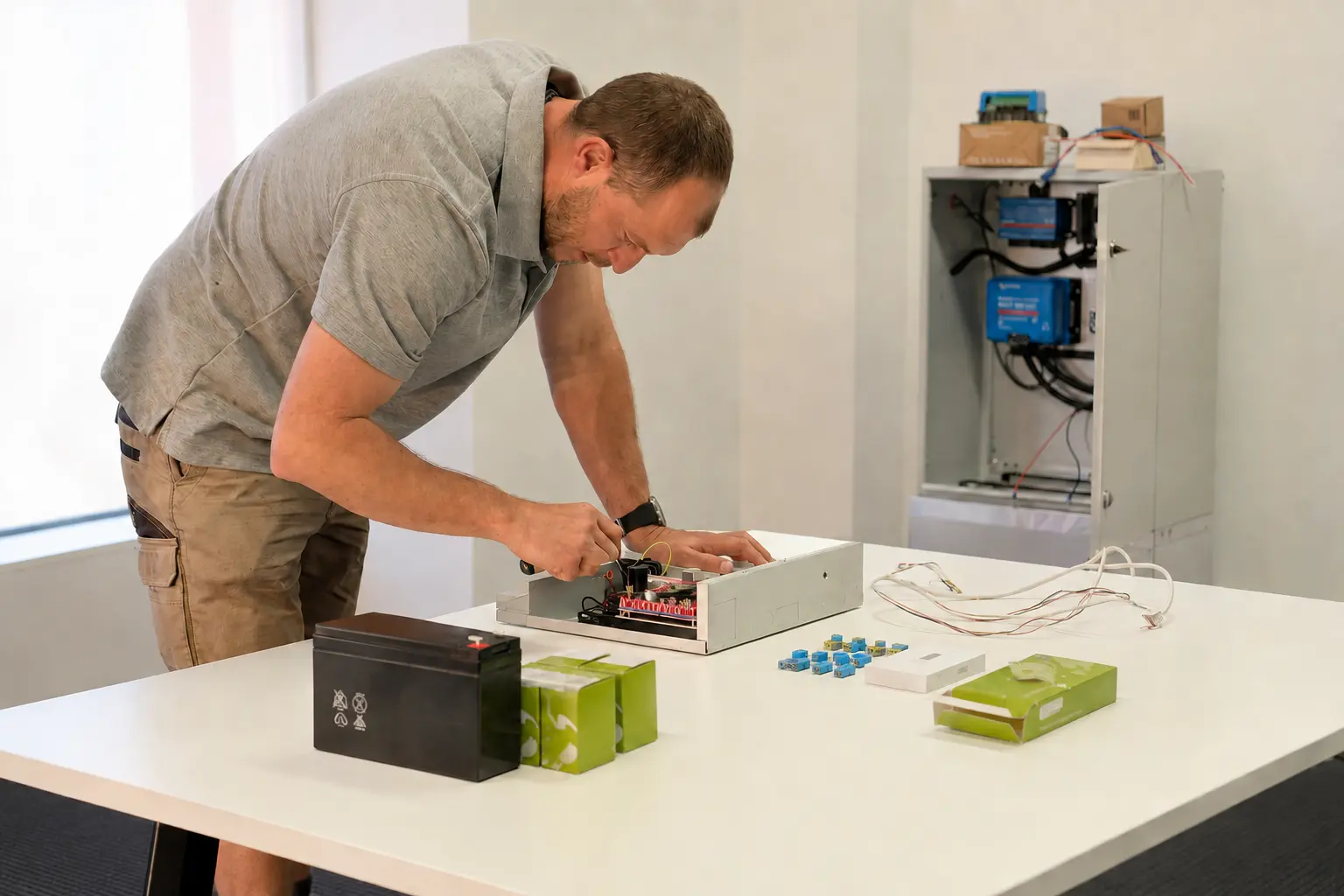
Equipment was assembled, configured, programmed, networked and comprehensively tested at Safeguard’s Melbourne facility before being shipped to site. More of the engineering work could therefore take place under controlled conditions, reducing uncertainty during deployment.
Safeguard also developed a communications approach that satisfied the organisation’s corporate IT separation requirements without exposing sensitive network or security architecture.
Each deployment followed the same core design while allowing for the physical and operational requirements of the individual site.
MELBOURNE PRE-DEPLOYMENT ENGINEERING
Assembled, programmed, connected and tested before it reaches site.
Preparing suitable systems in a replicated operating environment gives onsite technicians a known starting point and helps maintain consistent standards across distributed projects.
GREATER NATIONAL CONTROL
Authorised people could manage access through one interface.
The completed environment gave the customer central control of users, doors and alarm permissions across selected locations.
Authorised personnel could add or remove users, assign access across locations, control individual doors and alarm groups, review activity and access useful management reports.
Routine administration no longer had to begin with a technician travelling to the site and programming locally.
SUPPORT BEYOND INSTALLATION
Send a technician when something physical actually needs attention.
Safeguard continued supporting the environment remotely from Melbourne. System-health information allows many issues to be investigated before a technician is dispatched.
Where physical intervention is required, the technician can attend with a clearer understanding of the fault and the work likely to be needed.
CCTV health monitoring can also identify camera loss, recording failures, hard-drive problems, insufficient retention and unexpected changes to camera views.
An ongoing relationship should be earned—not enforced through technical lock-in.
The organisation received its administrative credentials and system documentation.
Safeguard encourages customers to understand and control their security systems. Larger organisations can appoint Safeguard to manage the environment remotely, but the customer retains appropriate oversight and a practical exit strategy.
The platform can be maintained by other suitably qualified technicians and integrators if circumstances change.
THE OUTCOME
From fragmented local systems to a supportable multi-site environment.
Safeguard delivered more than a collection of security products. It provided the customer with control, visibility and a supportable foundation for future change.
PROOF WITHOUT EXPOSURE
The operating outcome can be shared without exposing the customer.
This case study is deliberately anonymised. Customer identity, locations, network architecture, credentials, vulnerabilities and protected operational information remain confidential.
DISCUSS YOUR MULTI-SITE SECURITY ENVIRONMENT
Your sites should not become a collection of unrelated security systems.
If your sites use inconsistent systems, require repeated onsite programming or depend heavily on one proprietary provider, Safeguard can review what should be retained, improved, integrated or replaced.